
Subscribe to our newsletter
Receive the latest updates on sustainability and net zero, plus technical insights and smart product innovation
Subscribe to our newsletter
Receive the latest updates on sustainability and net zero, plus technical insights and smart product innovation



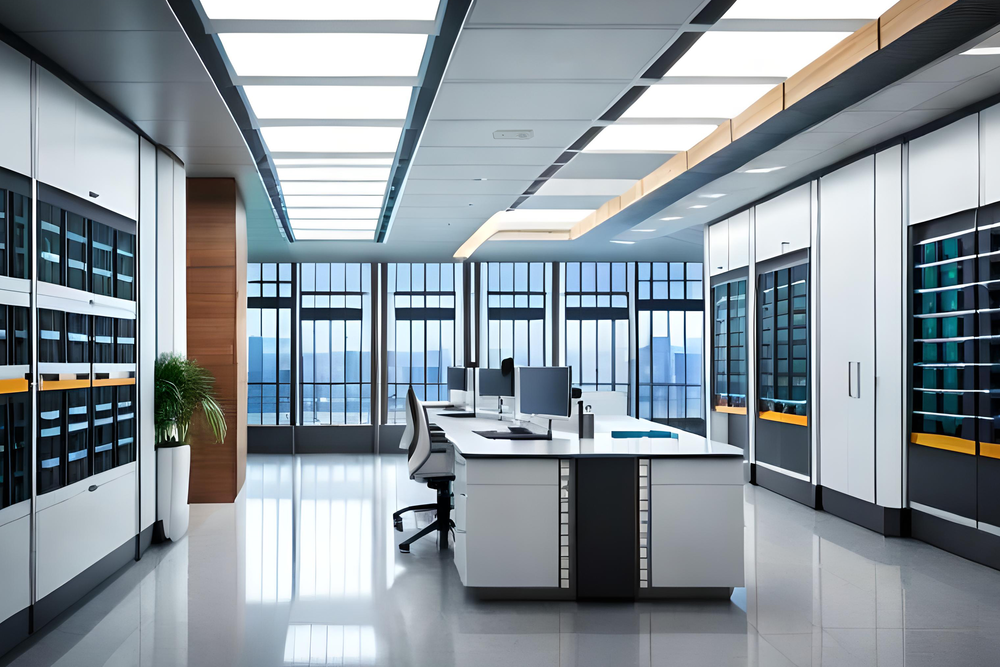
James Bennett, Professional Business, Market Leader, Signify UKI, explains how DC-powered lighting offers a gateway to modern, resilient, energy-efficient data centres.
Today, data centre operators face a convergence of challenges. Capacity requirements are accelerating due to AI-driven workloads, energy prices are rising, and expectations around sustainability and carbon reduction are becoming more stringent. In response, the industry is reexamining its electrical infrastructure. Direct current (DC) power architectures, once limited to niche applications, are gaining traction as a foundation for higher efficiency and greater operational resilience.
Within this shift, lighting – often treated as a peripheral system – can play a strategic role. DC-powered LED lighting combines high energy efficiency with relatively low implementation risk, making it an effective starting point for broader DC adoption. Beyond energy savings, lighting can also function as an intelligent layer within next-generation data centre infrastructure.
How power architectures are changing
Operating a data centre requires tight coordination between IT equipment, networking, cooling, security and electrical distribution. Historically, alternating current (AC) has been the default for power distribution. As facilities’ scale and power densities increase, however, electrical efficiency has become a primary design concern.
Early facilities relied on 48 V DC for backup systems – safe but capacity-constrained. This gave way to 230/277 V AC distribution, followed by 380 V DC for internal systems. Today, extreme power demands of AI servers are driving another transition, towards 650 V DC and even 800 V DC architectures.
According to the Open Direct Current Alliance (ODCA), 650 V DC represents the optimal level for building-wide distribution, balancing efficiency with safety, while organisations such as NVIDIA and the Open Compute Project are investigating 800 V DC. While promising high-power IT loads, these higher voltages do not yet deliver the same system-wide efficiency benefits as a facility-level 650 V DC approach.
Outside the data centre sector, industrial sites are already deploying 650 V DC systems to improve energy efficiency and resilience. One key advantage is the ability to capture regenerative energy from motor drives and robotics – energy that would otherwise be dissipated as heat. Because lighting is a continuous base load, it can readily absorb this recovered energy, reducing grid dependency and operating costs.
Integrating lighting, motors, renewables and storage on a shared DC grid reduces conversion losses, cuts copper usage through fewer conductors, and lowers transmission losses compared with 400 V AC systems. When paired with solar PV and batteries, DC grids also improve self-consumption, backup capability and flexible energy management.
What’s driving the move?
The momentum behind DC power in data centres is rooted in both engineering logic and economics:
DC power is therefore not just an alternative distribution method, but a pathway to smarter, more resilient infrastructure.

Lighting as the first step
Among all building systems, lighting is often the most practical candidate for early DC adoption. Connected LED lighting allows operators to pilot DC distribution with limited risk before extending it to mission-critical IT loads.
The benefits are tangible:
DC-compatible luminaires and components are already commercially available. For example, Signify offers a 100 W Xitanium LED driver designed for 620-750 V DC operation, integrated into the Pacific LED Gen5 and Maxos Fusion luminaire families. These solutions achieve up to 165 lm/W efficacy and can be paired with systems such as Signify Interact and Philips Dynalite. Driver-level efficiency can exceed 95%, with future potential to reach 200 lm/W through ultra-high-efficiency LED modules.
Sustainability and ESG outcomes
DC-powered lighting supports measurable sustainability objectives:
For hyperscalers such as Amazon Web Services and Microsoft Azure, as well as colocation providers, these outcomes translate directly into stronger ESG reporting and progress towards carbon neutrality.
Deployment approaches
DC lighting can be implemented incrementally. Some facilities deploy rack-level DC lighting while retaining an AC backbone. Others adopt facility-wide DC grids that integrate lighting, renewables, storage and IT infrastructure.
In larger deployments, centralised emergency lighting connected to the DC backbone ensures continuous illumination during outages, reinforcing safety in mission-critical spaces.
A strategic role for lighting
As operators prepare for the next phase of digital expansion, DC-powered lighting offers a practical, high-impact entry point into efficient, renewable-ready DC infrastructure.
Modern connected lighting systems extend far beyond illumination. With embedded sensors measuring occupancy, daylight, temperature, humidity and air quality, luminaires form a dense, facility-wide sensing network without the need for additional hardware. Using open protocols such as DALI, BACnet and MQTT, DC lighting networks integrate with building management systems and DCIM platforms, enabling predictive maintenance, enhanced operational intelligence, optimised cooling and space utilisation.
By simplifying cabling, reducing losses and enabling intelligent energy management, DC lighting transforms illumination from a passive load into an active contributor to resilient, sustainable data centre operations.
This article appeared in Electrotechnical News September/October 2026 edition – read it here




Subscribe to our newsletter
Receive the latest updates on sustainability and net zero, plus technical insights and smart product innovation